One of the most common questions we get on day one is 'when will I see results?' It's a fair question — you've just plugged in a new device and you want to know what to expect. The honest answer is that ultrasonic pest repellers don't work like a chemical spray. They're a slow-and-steady deterrent, not an instant kill, and the realistic timeline is 2–4 weeks for most households.
Here's what to expect at each stage, why some weeks may feel worse before they feel better, and when to consider escalating to additional treatments.
The 4-week realistic timeline
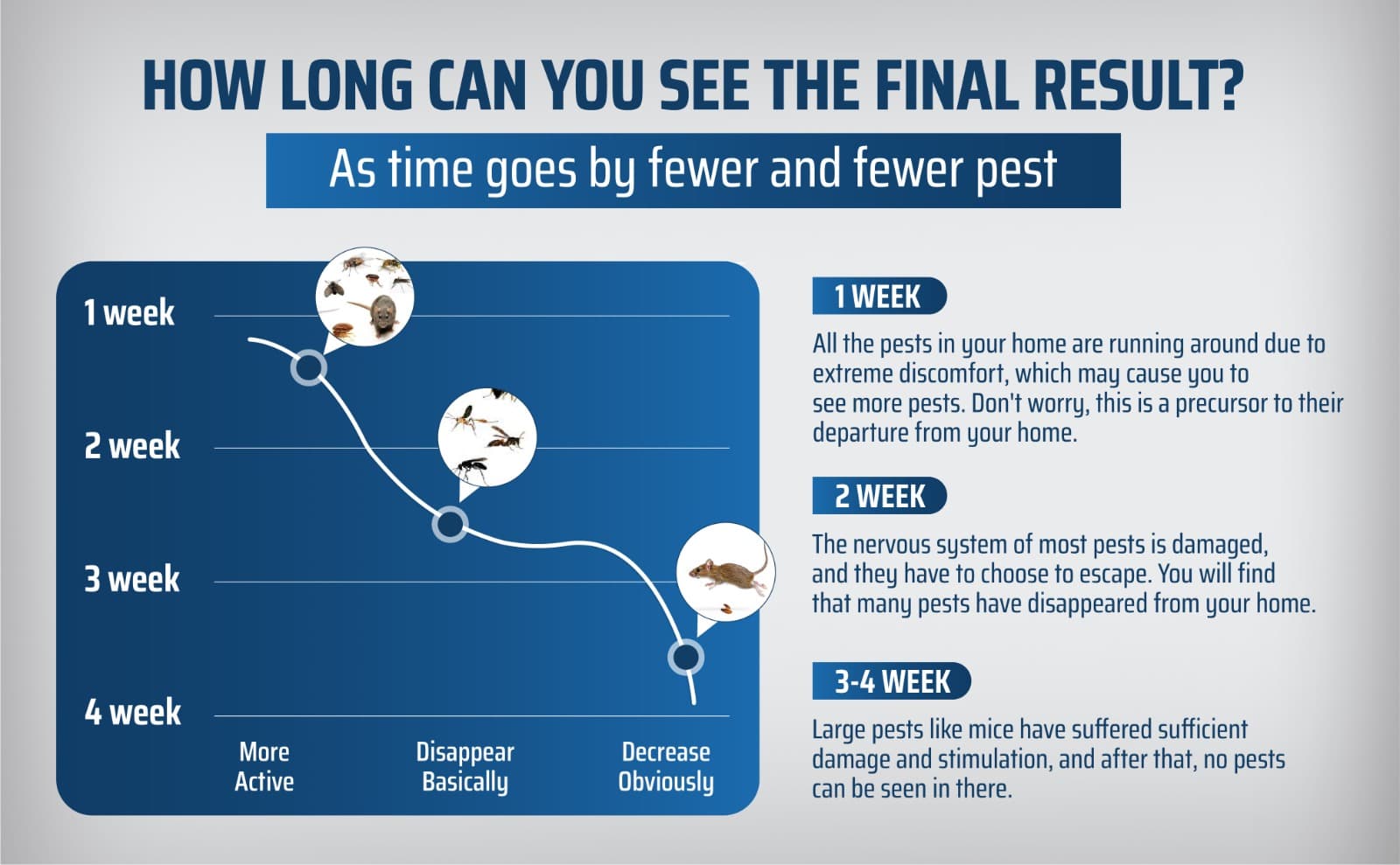
- Week 1 — Disturbance phase. You may actually see MORE pests during the first 5–10 days, not fewer. This is normal and a sign the device is working. Pests that were previously hidden in walls, behind appliances, or under cabinets are getting pushed into open spaces as they search for less-stimulated areas. This is when most customers panic and email us — please don't. Stay the course.
- Week 2 — Migration phase. By the end of week 2, you should start to see fewer pests in the open. They're consolidating into the rooms or areas farthest from the repeller units, or beginning to leave the home entirely through whatever gaps they came in through.
- Week 3 — Reduction phase. Activity in repeller-covered rooms drops noticeably. You'll probably stop seeing pests during your normal day-to-day. Most customers email us in week 3 saying 'I think it's working — I haven't seen anything in five days.'
- Week 4 — Stabilization phase. Most populations have either left the building or relocated to areas you've covered. You should be seeing minimal to no pest activity in any rooms with repellers. This is the new baseline.
Why pests seem more active in week 1
This catches a lot of customers off guard. You plug in the units, expecting peace, and suddenly you're seeing more roaches on the kitchen counter or more spiders on the wall than you did before. What's happening?
Pests that had established hidden nesting locations — behind your refrigerator, in wall voids, under loose baseboards — are being driven out of those refuges by the ultrasonic stimulation. They're not necessarily leaving your home yet; they're just being forced out of comfortable hiding spots. So they appear in places you haven't seen them before: counters, walls, floors during the day. This is the device working as intended.
If you're committed to ultrasonic-based control, your job during week 1 is essentially to do nothing dramatic — don't unplug the units, don't double-spray with chemicals (which can interfere with the migration pattern), and don't assume it's not working. Vacuum what you see, but otherwise wait it out.
Why the 4-week mark matters
Most pest populations operate on a generation cycle of about 21–28 days. Mice mature and breed in roughly 8 weeks, but their behavioral patterns — when they explore, where they nest, what they consider 'home' — adjust on a 3–4 week timescale. Cockroaches similarly take a few weeks to fully relocate a colony. By week 4, you're past one full behavioral adaptation cycle, which is why this is the realistic point to evaluate whether the system is working for your specific home.
If at week 4 you're still seeing significant activity, that's a signal something else is going on — usually a structural entry point that's continuously feeding new pests in (a torn vent screen, a gap under a garage door, a roof flashing issue). The ultrasonic devices are doing their job, but you have an unsealed perimeter.
Troubleshooting if you're not seeing results
If you've passed week 4 and still see notable activity, run through this checklist:
First, check coverage. Each unit covers up to about 1,200 sq ft, but ultrasonic waves don't pass through walls. If you have a 6-pack and a 2,500 sq ft home with multiple separated rooms, you may need a unit per major room. We've seen this issue most often in basements (one unit can't cover both the basement and the floor above) and kitchens (one unit at the edge of the room may not reach the pantry side).
Second, check entry points. Walk the perimeter of your home and look for gaps. A pencil-sized hole is enough for a mouse. If you have an active entry route, the repellers are pushing pests out but new ones are coming in faster than the deterrent works.
Third, consider adding a complementary measure: roach bait gel for cockroaches, perimeter sealing for mice, or essential-oil sprays for ants. Ultrasonic + sealing + targeted treatment for the worst offender is a much more effective stack than ultrasonic alone.
Fourth, if you've done all of the above and you're still seeing meaningful activity, you may have a structural issue that requires a professional. We're happy to talk through what you're seeing — email us and we'll help diagnose. And if it turns out our product just isn't the right fit, the 30-day return window has you covered.